









You sit down and set your mind to a task, then three minutes later, a colleague two desks over is asking you about a project update. Soon after, your meeting reminder is going off for a project meeting. All before 10am, your brain feels as if it has already run a marathon it didn't sign up for.
Sound familiar?
These scenarios are common in open offices. After all, they’re built for catching up, bouncing ideas, and the general hum of a team that's actually in it together.
Some of your team members may thrive in that. For those who don’t, they need somewhere quiet to disappear for a bit to get their best work out.
For a lot of Australian teams, the solution has quietly become: just work from home when it matters.
But it doesn't have to be that way. A dedicated quiet room at work gives your people somewhere to focus, recharge, or take that call without an audience.
Here's what it actually changes.
How Noise Turns a Productive Office Into a Chaotic One
Most offices don't think of noise as a business problem. It's just… background. Just put your headphones on and get on with it.
However, real-life office situations indicate something different.
- 275 interruptions a day: That's how often the average office worker is disrupted by meetings, messages, and background noise, according to Microsoft's 2025 Work Trend Index. Nearly half of all employees say their work feels chaotic and fragmented as a result.
- Similarly, Gensler's 2024 Global Workplace Survey found that 7 in 10 employees in open-plan offices experience regular disruption from nearby conversations.
Every single time it happens? Research says it takes up to 23 minutes to fully get back into focus. And this doesn’t happen just once a day.
That's 23 minutes multiplied dozens of times a day, quietly eating into the hours your team was hired to spend thinking, creating, and making good decisions.
Compare that to remote workers who clock in more than 4 extra hours of deep, focused work per week, according to Hubstaff’s research. That adds up to 62 extra hours of productive time per year, and it’s driven entirely almost by one thing: acoustics.
The Benefits of a Quiet Room at Work
Quiet space is often treated as a luxury in open offices, something nice to have if there’s room for it. In reality, it’s one of the most practical features a workplace can offer.
These are the changes that happen when your team has somewhere quiet to go.
-
Productive focus
The kind of work that actually moves things forward, such as writing a brief, reviewing a contract, and putting together a financial report needs your brain fully in it.
The problem is that the human brain is wired to notice speech.
Even a conversation you’re not part of will pull a slice of your attention, whether you want it to or not. So every time the sales team kicks off a debrief three metres away, part of your brain is already halfway across the room.
Headphones help. But they only pull you away from the noise, they don’t remove it.
In a quiet room, you get thirty minutes of uninterrupted thinking time. That's often enough to produce a better output than two hours of fragmented effort at a shared desk. -
Less stress, fewer burnt out Friday
Noise stress doesn't feel like stress at first. It feels more like tiredness.
But what’s truly happening is physical. Your body treats unpredictable noise as something worth paying attention to, and it responds by keeping your nervous system on edge all day.
While a quiet room won’t give you back that energy, it provides you with somewhere to step out of that state. Even twenty minutes away from the floor between a difficult call and your next meeting can change how the rest of the day feels. -
Better thinking flow
Psychologist Mihaly Csikszentmihalyi identified the feeling we often associate with “being in the zone” as a state of “flow.”
In this state, you are not just reacting to what’s in front of you but actually making connections, spotting patterns, and coming up with new approaches.
But it can only be achieved in spaces like quiet rooms where your mind can be fully committed to strategising, problem solving, or designing, not half-listening to someone's call two rows over.
-
Private conversations stay private
Your team may have a tight-knit office culture, but conversations about contract renewals, performance evaluations, audits, etc., are still best kept among only those involved.
But in open offices, that often means:
- Booking a meeting room designed for six people just for a 15-minute call.
- Finding a quiet corner by the hallway and hoping for the best
Neither is ideal.
A dedicated quiet booth provides space for these conversations. Sensitive conversations happen in private, and the rest of the floor doesn't have to pretend they didn't hear anything. -
A space that works for everyone
For employees with ADHD, autism, anxiety, or sensory sensitivities, a loud floor isn't just distracting. It's genuinely exhausting in a way that compounds over a full day and a full week.
Under Safe Work Australia's psychological health and safety guidelines, Australian employers have a responsibility to manage psychosocial hazards in the workplace. Excessive noise is one of them.
A quiet room is a concrete, visible way to meet that responsibility without overhauling your entire office.
It also tells your whole team: We've thought about how different people work, not just the ones who thrive in noise.
That kind of thoughtfulness tends to show up in how people feel about their workplace. And how long they stay.
How to Create a Quiet Zone in Your Office
Creating a quiet zone in your office won’t require a huge budget. Here are some practical ways to make that happen.
-
Zone it and name it: Designate a specific area as a quiet zone and make it obvious. Name it something like "The Focus Room" or "The Deep Work Den", and put it somewhere your team will actually use.
-
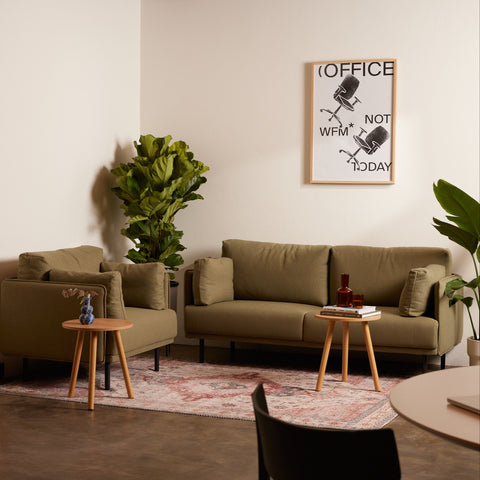
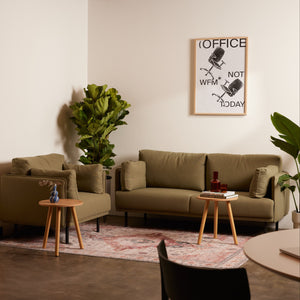
Add soft furnishings: Hard surfaces bounce sound around. On the other hand, rugs, upholstered chairs, fabric wall panels, and a few plants all help absorb noise and make a space feel calmer.
For a deeper dive into acoustic treatment options, read our guide on how to soundproof an office.
-
Position your quiet zone strategically: Keep your quiet zone away from the kitchen, the main walkway, and any collaboration areas. Instead, tuck it into a corner or against an outer wall to create an acoustic bubble without touching a single partition.
-
Set simple rules within the zone: Phones on silent. No food. A maximum booking time of 90 minutes so the space stays accessible for everyone.
-
Consider a soundproof booth: If you don't have a spare room, or you want consistent, certified acoustic performance without any construction, a soundproof booth is worth a look.
Not sure which type suits your space? Our complete guide to office pods in Australia walks through all the options. More on that below.
Quiet Room vs Soundproof Booth: Which One Suits Your Office
Both solve the same core problem. They just do it differently.
Here’s a quick overview of how they compare:
A dedicated quiet room works well if you have the space, the budget, and a floor plan that can genuinely support it. It will become a permanent part of your office and a clear signal that focused work is valued here.
For many Australian offices though, a soundproof booth is the more practical option. With this, you won’t have to worry about construction, disruption, and waiting around.
The figures above are drawn from what premium soundproof booths on the Australian market actually deliver.
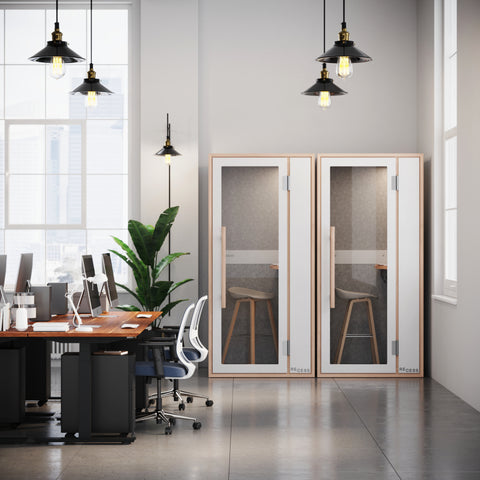
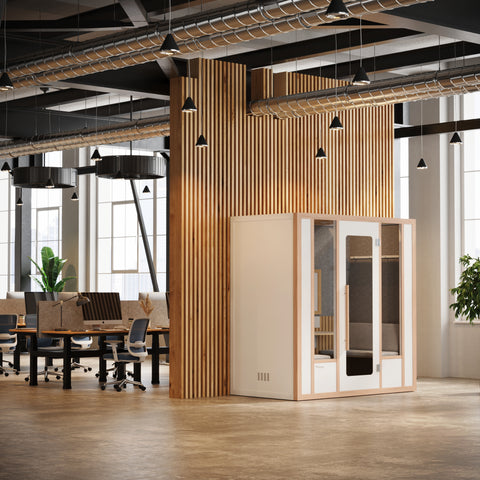
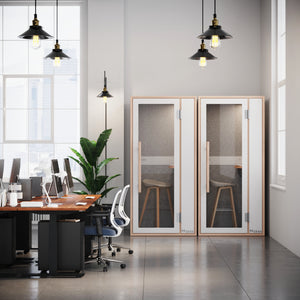
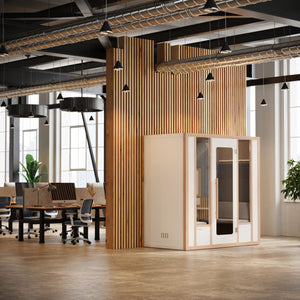
Two soundproof pods that hit the mark include Recess's Nook and Cove. The Nook is a solo focus booth and phone pod, and The Cove seats up to four for private meetings or small team sessions.
Both are made from FSC-certified timber, which is wood sourced from responsibly managed forests, and recycled PET acoustic panels, which are sound-absorbing materials made from reclaimed plastic bottles.
Each booth is made with enough recycled PET panels to divert between 1,200 and 2,400 plastic bottles from landfill. And because those panels are modular and repairable, they're designed to last well beyond the typical office refresh cycle.
This reflects Recess’ belief that a well-made workspace and a sustainable one don't have to be mutually exclusive.
With either booth, you're getting something Australian-made, thoughtfully built, and genuinely better for the environment. A win for your team, and a win for the planet.
Ready to Give Your Team Somewhere to Think?
If you find your employees doing their best work at their kitchen table, it might be time to bring that quiet back to the office.
Browse our soundproof booth collection, or get in touch with us to understand which one will work best for your team. We're here to help you build a workspace your team actually wants to be in.
FAQs
Do quiet rooms actually improve productivity?
Yes. A 2026 workplace noise study found that reducing acoustic distractions by even a moderate amount can lead to 30 to 50% improvements in output on focus-heavy tasks.
What should a quiet room at work include?
Keep it simple: comfortable seating, good lighting, power outlets, and soft furnishings to absorb sound. A booking system and a short list of house rules also help the space stay usable for everyone.
How do you stop people from using the quiet room as a nap room or second office?
A short, clear set of house rules does most of the heavy lifting.
Set a maximum booking time of 60 to 90 minutes, use a shared calendar so everyone can see availability, and be specific about what the space is for.
Is a quiet room worth it for a small office or startup?
Yes, more so than for a large one.
In a small team, one loud conversation affects everyone. There's nowhere to escape to, and the social awkwardness of putting headphones on to drown out your colleagues gets old fast.
A soundproof booth is often the most practical answer for a startup or small office. There is no commitment to a permanent room, no construction, and it moves with you if you change spaces.
How do you know if your office actually needs a quiet room?
A few signs worth paying attention to: meeting rooms are constantly booked out but only one or two people are ever in them, your team is putting headphones on the moment they sit down, people are coming in later or leaving earlier to avoid the peak noise hours, or conversations that should happen in private are happening in stairwells and empty kitchens.
Any one of those is worth taking seriously.
Author Bio

Will Tungusov is the founder of Recess, a Sydney-based sustainable office furniture startup transforming hybrid workplaces across Australia. Since launching in 2019, Will has led Recess from creating the award-winning Nook soundproof booth to offering a complete range of ergonomic, eco-friendly office solutions. With a focus on eliminating middlemen and prioritising sustainability, Recess has served notable high-growth Australian startups, including Eucalyptus, Lorikeet, Instant One and Tracksuit. Will is passionate about building beautiful, functional workspaces that "don't cost the earth," both environmentally and financially.