





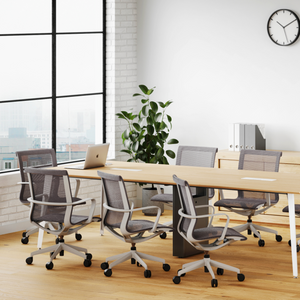
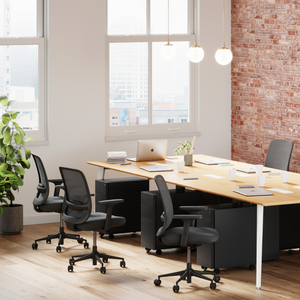





Some businesses choose open plan layouts because it's cheaper, while others prefer private offices because it feels more professional. Neither of those reasons, on their own, says much about how well the space is used to actually support the people using it.
Instead, the question that truly matters is “Which layout helps your people do their best work?”
Discover the pros and cons of how these various types of office layouts perform across the factors that drive real productivity in your team and how well your space holds up as the team grows.
How Private Office vs Open Space Affects Your Team’s Performance
Collaboration and team culture
An open plan makes people talk more.
When there's no wall between you and the person three desks over, questions get asked out loud instead of being sent as a message that takes 20 minutes to get a reply. Or someone overhears a conversation and chips in.
This is one of the key benefits of open office designs. The spontaneous communication that happens within the open space simply can't be replicated as easily elsewhere.
It’s this collaboration that encourages 68% of employees to come into the office as per CBRE's 2026 Workplace Report. For any Australian business paying rent on a commercial office space, this is the whole point.
The problem is that noise tends to trample it before it gets going.
Once an open floor gets loud enough, people plug their headphones in and keep their heads down. Then, the ideal picture of a collaborative workplace dissipates.
Private offices aren't automatically bad for culture either.
Teams with good habits, such as the following, can stay connected regardless of layout.
- Regular check-ins
- Shared spaces
- A management that consistently stays present
It just requires more intention than an open floor does by default.
Cost considerations
Cost is usually the first reason businesses choose an open plan, but there’s more you have to consider than fitout price alone.
What it costs to build
With no need for partition walls, individual HVAC runs, or door hardware, open plan layouts are significantly cheaper to build.
In cities like Sydney and Melbourne, where commercial rent is ranked among the highest in the Asia-Pacific region, that makes a huge difference.
Data from JLL's Global Fit-Out Cost Guide states that open-plan fitouts generally run around $1,900 - $2,300/sqm. A traditional layout with private offices and enclosed meeting rooms comes in at roughly $2,100 - $2,600/sqm.
For a 200m² office in Sydney, that difference can be somewhere between $40,000 and $60,000 before you've bought a single chair.
Ongoing and hidden costs
When executed poorly, open plan layouts can also incur the costs you supposedly saved upfront. The risks include:
- Higher sick leave — desks close together mean colds, flu, and other illnesses spread faster.
- Lower productivity — noise and constant interruptions make it harder to focus, which shows up in slower output and more errors
- Higher staff turnover — people who can't work the way they need to will eventually find somewhere they can
Meanwhile, private offices carry higher ongoing maintenance tasks:
- More rooms to clean and maintain
- Less efficient use of heating and cooling, particularly in older buildings without centralised systems
- More complex building management as the office grows
Focus and productivity
While open plan offices are cheaper to finance, there is a trade-off you might be risking: your team’s ability to concentrate.
The main culprits are noise and distractions. A peer-reviewed study published in the Journal of Management and Organization found that open-plan office noise can reduce psychological wellbeing. Participants showed changes in mood, heart rate, and physiological stress responses compared to those working in quieter private office conditions.
That said, open plans can still drive performance for teams doing fast-moving, communicative work.
In private offices, a closed door removes the ambient noise, the visual distractions, and the social pressure of being watched. You can settle into longer stretches of concentrated work.
For professionals such as developers, analysts, finance and legal experts, that quiet can also be a crucial part of their productivity and efficiency.
There's also something to be said for ownership. Having a consistent space, one that's yours and set up the way you work, reduces the low-level friction that accumulates in hot-desking environments.
People stop spending ten minutes every morning plugging in cables and adjusting a chair that was last used by someone 15cm shorter.
Scalability and flexibility
For teams that are growing, restructuring, or are just not sure what the next 12 months could look like, an open plan is the lower-risk option. Changing this setup doesn't require:
- Permits or council approvals
- Tradespeople and weeks of disruption
- Writing off a room that no longer serves its original purpose
On the contrary, every closed room in a private office is a fixed commitment. When your company grows, you're either looking at underused space you're still paying rent on, or a construction project to reconfigure it. Neither is cheap.
But this inflexibility only becomes a problem when circumstances shift, and the layout can't follow.
Wellbeing and retention
Gallagher's 2024 Workplace Wellbeing Index, one of Australia's largest studies on employee wellbeing, surveying over 2,400 workers, found that employees with high wellbeing are 3.4 times more likely to stay with their employer. It also found that 10% of Australian employees have already resigned specifically because of a lack of wellbeing at work.
Your office’s physical environment directly affects that. A layout that creates daily friction, noise stress, or a lack of privacy could break down your employees’ wellbeing and productivity, regardless of how good everything else is.
Where each layout can go wrong:
Open plan done poorly:
- Noise stress accumulates across the day
- No private space for sensitive conversations
- People disengage and retreat behind headphones
Private offices done poorly:
- Isolation chips away at team culture
- Spontaneous communication disappears
- Junior staff lose access to informal learning
Neither layout is inherently good or bad for wellbeing. Both depend on how well they're designed and what the team actually needs from them.
Hybrid setups
As per the Australian HR Institute's 2025 Hybrid and Flexible Working Report, 82% of Australian employers expect hybrid work to remain stable or increase over the next two years.
This creates another decision factor for your office layout because the same space that has to work for 8 people on a quiet Thursday also has to work for 20 people on a busy Tuesday.
Open plan layouts with hybrid work setups
Open plan layouts handle a hybrid work setup reasonably well. A flexible, unassigned floor can absorb fluctuating attendance without wasted space.
Most Australian offices also now plan for around 80% occupancy on any given day, which means a 20-person team may only need 16 workpoints. That frees up the budget for better shared spaces or acoustic booths.
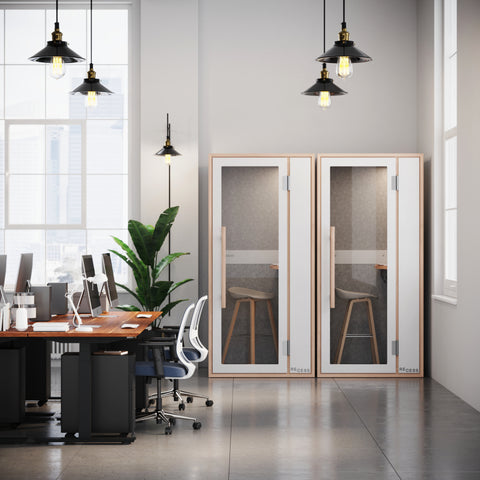
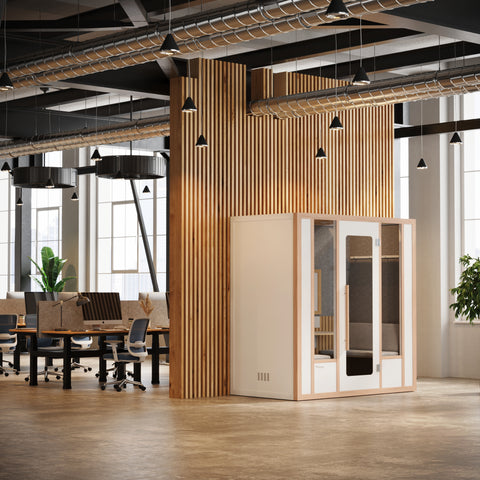
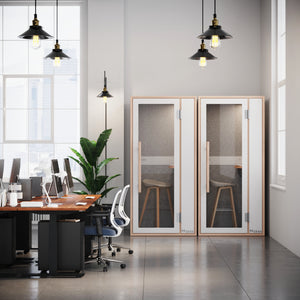
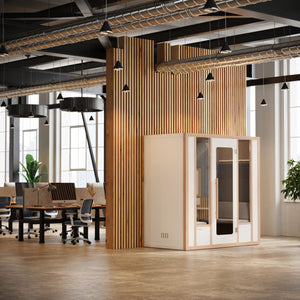
A few great options for these are Recess’ the Nook and Cove. The Nook is great as a solo workspace and is equipped with up to 32dB sound reduction, built-in ventilation, and a plug-and-play power setup. The Cove is set up for up to four people who need an enclosed space for meetings. Both assemble without construction and move with you if the layout changes.
The catch is peak days. An open floor that feels fine at 60% capacity can turn unpleasant at 95%. If the layout isn't designed for the busiest day rather than the average day, people notice, and more might start opting to stay home instead.
Private offices and hybrid work setups
Private offices, on the other hand, have more of a cost justification issue in terms of maintaining a hybrid work setup.
A dedicated room sitting empty three days a week is expensive real estate with poor utilisation. That is, unless the role genuinely demands it, such as those in senior leadership, confidential functions, or roles where uninterrupted focus is the whole job.
The workaround some businesses are finding is to have fewer permanently assigned private offices, with one or two bookable enclosed rooms available to anyone who needs them that day. This way, you keep the utility of private space without paying for it at a 1:1 ratio.
Private Office vs Open Space at a Glance
Which Layout Suits Which Business?
1. Early Stage and Growing Teams
For many businesses in their early stages, the layout decision can hinge on which one you can afford to get wrong.
For instance, what worked when you had 12 people might not hold up once you’ve grown to 25. Open plan layouts can adapt more easily to such situations.
A couple of soundproof booths can provide privacy or quiet spaces without locking you into anything structural.
2. Legal and financial services
The core operations of this industry include:
- Client confidentiality
- Sensitive financial data
- Format meetings
So, private offices aren’t a preference but rather a compliance consideration.
What's less obvious is how much this shapes culture, too. The legal sector, in particular, tends to run on seniority, and private space is part of that structure. Changing the layout can feel like changing the hierarchy.
3. Creative and tech teams
These teams tend to do two very different kinds of work. One does fast, iterative collaboration while the other needs long stretches of heads-down focus, often in the same day.
A hybrid setup with open benching and a couple of bookable quiet booths is best equipped to handle both team’s needs.
4. Media and PR firms
The pace of this work, which includes pitches, deadlines, client calls, and reactive news cycles, suits the open plan well.
However, there is also a need for an acoustically isolated space, bookable by the hour, where journalists, copywriters, and strategists can disappear with a brief and come back with a draft.
5. Real estate agencies
An agency floor with six agents simultaneously negotiating offers, chasing vendors, and managing settlement queries creates a noise level that makes it hard for anyone to communicate clearly.
This can be relieved by dedicated call booths positioned away from the main floor, so agents can have private conversations without disrupting everyone else and without competing for the boardroom.
6. Professional service firms (accounting, consulting, HR)
The work in these industries is largely individual and detail-heavy. Additionally, these professionals also often need a presentable, private space for client-facing conversations.
With that, assigned desks and enclosed meeting rooms tend to serve this group better than open benching, even if the floor is relatively quiet.
Build the Space Your Team Needs
Private offices and open plans both work for the right team, in the right context, with the right setup. So when you do make the call, consider your team's daily work rhythms, your budget, how fast you're growing, and what your people genuinely need from a space.
Get those right, and the layout decision largely makes itself.
Whichever layout you choose, the right setup can make it more sustainable for your team. If you’re looking for tried and tested options, check out Recess collection of chairs, desks, and soundproof booths. We also offer discounts on bulk orders.
Not sure which works for your office? Get in touch with our team for recommendations.
Author Bio

Will Tungusov is the founder of Recess, a Sydney-based sustainable office furniture startup transforming hybrid workplaces across Australia. Since launching in 2019, Will has led Recess from creating the award-winning Nook soundproof booth to offering a complete range of ergonomic, eco-friendly office solutions. With a focus on eliminating middlemen and prioritising sustainability, Recess has served notable high-growth Australian startups, including Eucalyptus, Lorikeet, Instant One and Tracksuit. Will is passionate about building beautiful, functional workspaces that "don't cost the earth," both environmentally and financially.