







The promise of the open office design was collaboration, to be a space where ideas flow freely, teams stay connected, and energy stays high. And to be fair, that promise isn't entirely wrong.
For a lot of Australian teams, however, the reality of privacy in an open office is something closer to managed chaos.
Everyone can see and hear everything, all the time. You might have a colleague on a client call two desks over or someone else debriefing yesterday’s meeting loudly.
The harder people try to focus, the more obvious it becomes that the design wasn't really built for the way work actually happens.
In this post, we’ll break down why open plan office privacy is genuinely difficult to achieve and what you can do about it, from low-cost tweaks to the fix that actually sticks.
Why Do Open Offices Struggle with Privacy
Open offices were built on the idea that if you put people together and reduce barriers, collaboration follows naturally. And for some things, such as quick questions, team energy, and visibility for newer employees, that logic holds.
The problem is that the design is optimised for one kind of work and assumes everything else would adapt around it.
A Harvard Business School study found that moving to open-plan offices actually reduced face-to-face interaction by around 70%, the opposite of the intended effect.
Workers didn't suddenly collaborate more. Instead, they put on headphones, moved to digital messaging, and found ways to create the privacy that the physical space wasn't giving them.
The reality is, in many modern offices, employees split their day between genuinely collaborative moments and work that requires sustained focus or confidentiality. Those modes need different environments.
How a Lack of Privacy Affects Your Team and Your Business
The workarounds people use to cope with a lack of privacy in open offices have real consequences for individuals, for culture, and for the business. These include:
Weakened focus and output
When someone can't find a private space for a task that needs one, they either do it distractedly or self-consciously or are interrupted in the open. They may also delay it entirely.
According to the findings of Gloria Mark, Chancellor's Professor of Informatics at UC Irvine, which were published in her book Attention Span, the average worker now spends just 47 seconds on a task before switching or being interrupted. This is down from two and a half minutes in 2004.
In an open-office layout where those interruptions are constant, many employees may never reach the depth of concentration their work actually requires.
Reduced wellbeing and psychological safety
Lack of privacy is consistently linked to higher stress, lower job satisfaction, and a reduced sense of psychological safety. In Australia, these issues are directly covered by Australia's Work Health and Safety (WHS) laws which require employers to manage psychosocial hazards.
Retention
AHRI's 2025 Hybrid and Flexible Working report found that 44% of employers cite higher employee retention as a direct benefit of giving people more control over where they work.
The underlying reason is that employees value time away from the office specifically to focus, while they come in for connection and collaboration.
An open-plan office that can't support both modes removes one of the few reasons they'd choose to come in at all.
How to Create Privacy in an Open Office

The good news is that open plan office privacy doesn't require a full fitout or months of approvals. There's a wide range of solutions from things you can do this week to more long-lasting changes that will genuinely transform how your team works.
Quick Fixes to Increase Employee Privacy in an Open Office
- Privacy screens and desk dividers: A simple visual barrier cuts line-of-sight distraction and gives each person a small sense of a defined space. They may not be soundproof but they help with the psychological experience of privacy.
- Noise-cancelling headphones policy: Formalising when headphones signal "do not disturb" gives people a socially acceptable way to protect focus time without having to say a word.
- Indoor plants as visual buffers: Greenery along desk clusters softens sightlines, breaks up the expanse of the open floor, and makes the space feel less exposed.
- Designated quiet hours: A no-calls, no-meetings window (say, 10am–12pm) gives the whole team permission to go heads-down simultaneously with no guilt and no social friction.
These solutions address how people feel about the open office without changing its acoustic reality. If your team's privacy issues are bigger than this, these may not be enough.
If you want to go deeper on acoustic treatments, including panels, ceiling tiles, sound masking, and how sound actually travels through an office, our guide to soundproofing an office covers the technical side in full.
Medium-term Changes (Spatial and Cultural Redesign)
These solutions require intentional decisions about how your existing floor plan actually functions. The focus is on behaviour and layout, including where people go, who sits next to whom, and whether the space makes it easy or hard to protect focus time.
-
Zoning the floor: Designating areas as quiet zones and collaboration zones only works if leadership models the behaviour and the norms are set explicitly.
This way, you give people who need to talk somewhere to go, and the quiet area naturally gets quieter without anyone being told off.
-
Group by work mode, not just by team: High-talkers near heads-down focused roles is a recipe for low-level resentment in an open plan office.
Rearranging employee clusters by work mode, even partially, can reduce friction without changing a single square metre of your floor plan.
- Use lighting to signal intent: Warmer, dimmer lighting in quiet zones and brighter task lighting in collaboration areas subtly shape behaviour without signage. People naturally lower their voices in a calmer space.
These changes may take a few weeks to implement, but don't require a builder, a lengthy approval process, or significant capital. They do require a manager willing to have the conversation with their team, which can often be the harder part.
The Long-Term Fix: No Construction Required
While zoning and cultural norms can help, they have a ceiling. For employees who need a more dedicated space for work, such as hosting a sensitive conversation or doing an hour of genuinely uninterrupted work, a physically separate, acoustically controlled space may be the best option.
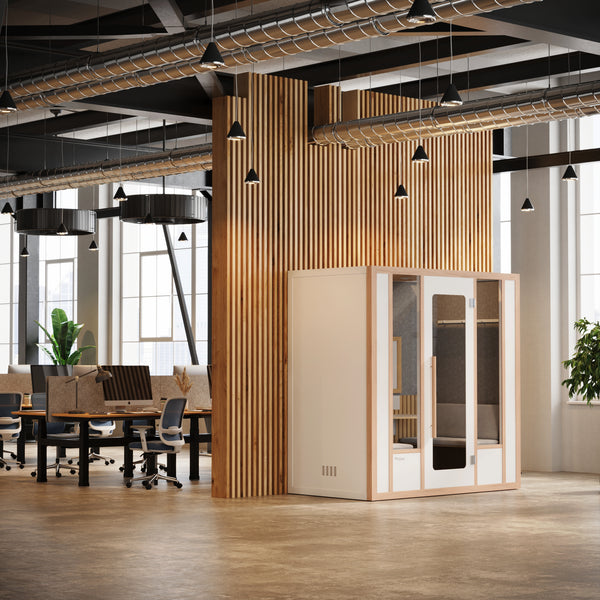
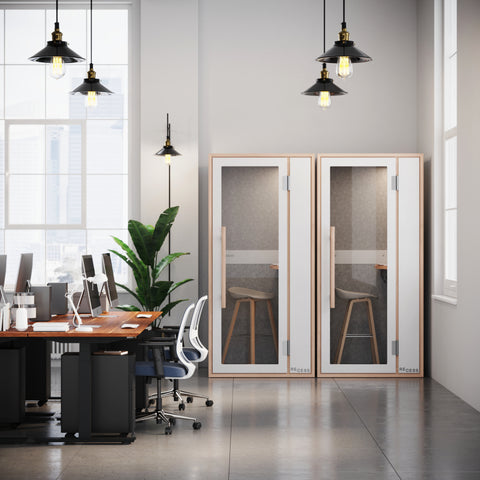
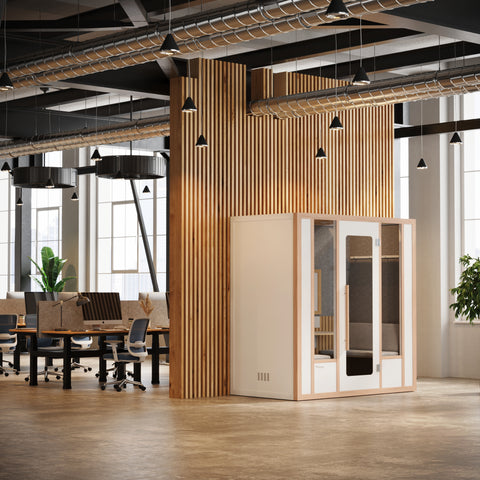
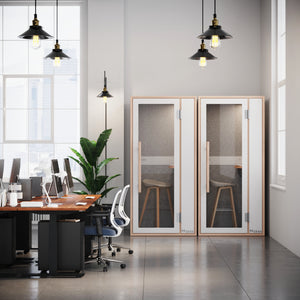
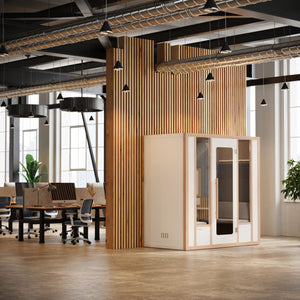
This is what soundproof booths and acoustic office pods solve. Unlike quiet zones, a well-designed pod creates complete separation from the open floor.
They're also not permanent structures. A quiet booth can be relocated as your team grows or your floor plan evolves. And the best options today are designed to look like they belong in a planned workspace, rather than a temporary fix someone sourced in a hurry.
How to Choose the Right Soundproof Booth for Your Office
In an open-plan context, a mismatched soundproof booth may become an expensive piece of furniture nobody uses rather than a long-lasting privacy solution. Here’s what to evaluate before committing.
-
Prioritise adoption over specs
A booth that's stuffy, poorly lit, or inconveniently placed will sit empty within a month. So, prioritise active ventilation, good internal lighting, and a location on the floor that feels accessible rather than tucked away.
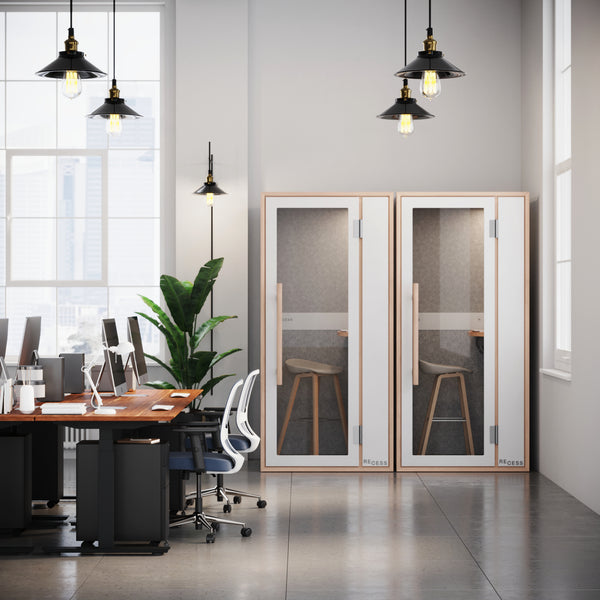
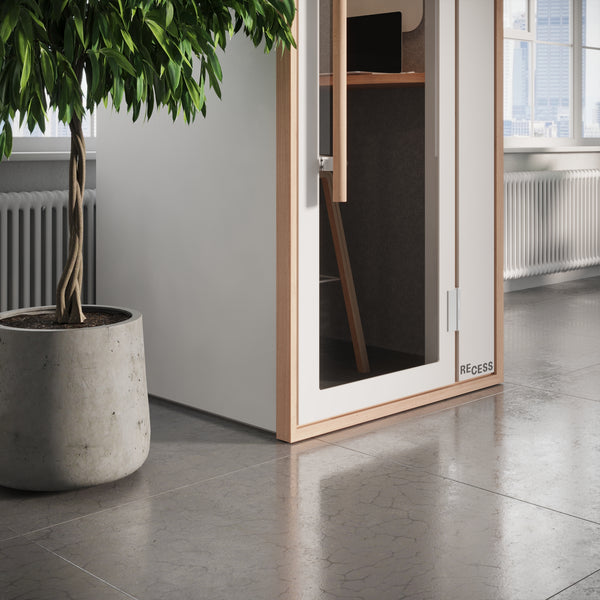
The Nook, for instance, has a silent motion-sensor fan that recycles the air inside the booth every 3-4 minutes, ensuring a consistent flow of fresh air. These soundproof booths can accommodate one person and have lights spread evenly within the space to keep you productive while you work.
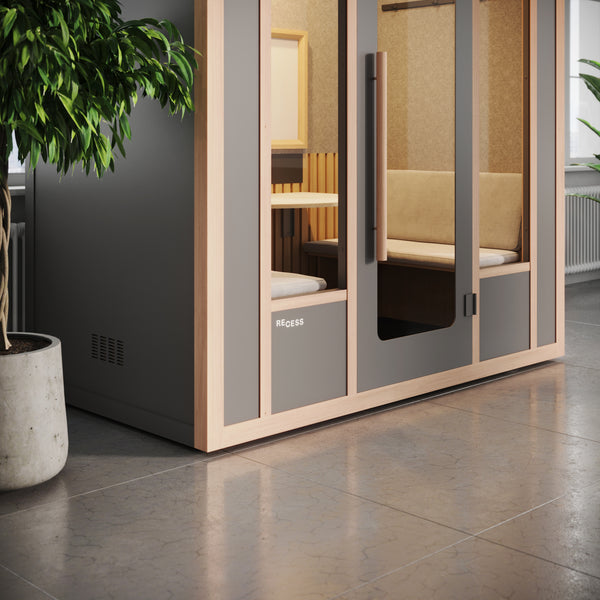
If you need space for more, the Cove seats up to four. They’re built for one-on-ones, HR discussions, and small team check-ins that need genuine privacy, not just a quiet corner.
-
Buy for the floor, not just the desk
One booth rarely solves a floor-wide privacy problem. Think about how multiple units work as a system. Do they create a coherent look, and does the supplier design them to work together across a space?
-
Ask for a specific soundproofing figure
Vague claims about "noise reduction" aren't enough. Ask for a dB figure and the test standard it was measured against.
A 30dB reduction is the general threshold worth aiming for in a real workplace context. At this level, you can have a conversation that is inaudible at a nearby desk.
-
Confirm it can move
A fixed booth is essentially a permanent structure. If your team grows, your floor plan changes, or you move offices entirely, it stays behind.
A portable booth gives you the opposite: the flexibility to reposition as your needs evolve, without a builder or council approval in sight. Recess’ booths are delivered and assembled by a professional team, so setup is straightforward from day one and just as straightforward when it's time to move.
-
Match it to your fit-out
In an open office where everything is visible, a booth that looks out of place actively undermines the space. For example, a bulky unit that overwhelms a compact floor, clashes with your colour palette, or simply doesn’t fit how your team works.
If it looks like a temporary fix, it gets treated like one.
For a full breakdown of how to compare pods and what to look for when buying, scan through our soundproof pods for offices guide for more details.
Give Your Team the Privacy They've Been Working Around
Open offices work well for visibility, energy, and spontaneous connection, however, they don’t give people privacy when they need it. That gap chips away at focus, well-being, and retention in ways that are easy to underestimate.
To prevent growing dissatisfaction among your team in terms of their workspace, start with norms and zoning, layer in spatial changes when you're ready, and when those hit their ceiling, upgrade to a reliable soundproof booth.
If you’re ready to provide your team the space and privacy they need, explore the Recess soundproof booths collection.
Not sure which one suits your space? Book a call with the Recess team, and we'll help you work it out.
Author Bio

Will Tungusov is the founder of Recess, a Sydney-based sustainable office furniture startup transforming hybrid workplaces across Australia. Since launching in 2019, Will has led Recess from creating the award-winning Nook soundproof booth to offering a complete range of ergonomic, eco-friendly office solutions. With a focus on eliminating middlemen and prioritising sustainability, Recess has served notable high-growth Australian startups, including Eucalyptus, Lorikeet, Instant One and Tracksuit. Will is passionate about building beautiful, functional workspaces that "don't cost the earth," both environmentally and financially.